Modify the GUI Tic-Tac-Toe program to allow users to select players
to play Tic-Tac-Toe. Maintain a saved record of each player
including name, avatar, type, security, and Universe (for now, all
players will have Universe = ”Public Universe”; security will be
“Admin” if type is Human and None if type is “Random”).
When a player of Type - Random is playing (or augmenting) a turn,
compile a list of all legal sets of moves for that turn for each piece,
counting each reserve piece individually, then pick randomly from that
list. For example, if Random had two black circles and one white triangle
in reserve, and could pass, and there were two empty spaces in which
Random could play (“A” and “B”), then Random would choose “White
triangle To A” 1/7th of the time, “White triangle To B” 1/7th of the
time, “Black circle To A” 2/7th of the time, “Black circle To B”
2/7th of the time, and “Pass” 1/7 of the time.
Permit each user to be augmented by a non-human
player (just “Random” for now). If the timer runs out before the user
confirms a move-selection, then the non-human makes the move; if the
type of augmentation is “Reviewing” then the non-human player prefills
the move for the user (but the user can change it), if the type of
augmentation is “Delegating” then the non-human does not prefill the
move (but the user can expire the clock early by clicking accept
without selecting a move).
Test each of the clickable elements and test that it displays
appropriate errors for invalid entries. Create at least three
Random players. Play all three forms of augmentation against Random.
To test that a Random player does not settle on predictable behavior,
undo and repeat to see that it plays differently. Close Python and reopen
it to confirm that it remembers the players names, avatars, types,
and security.
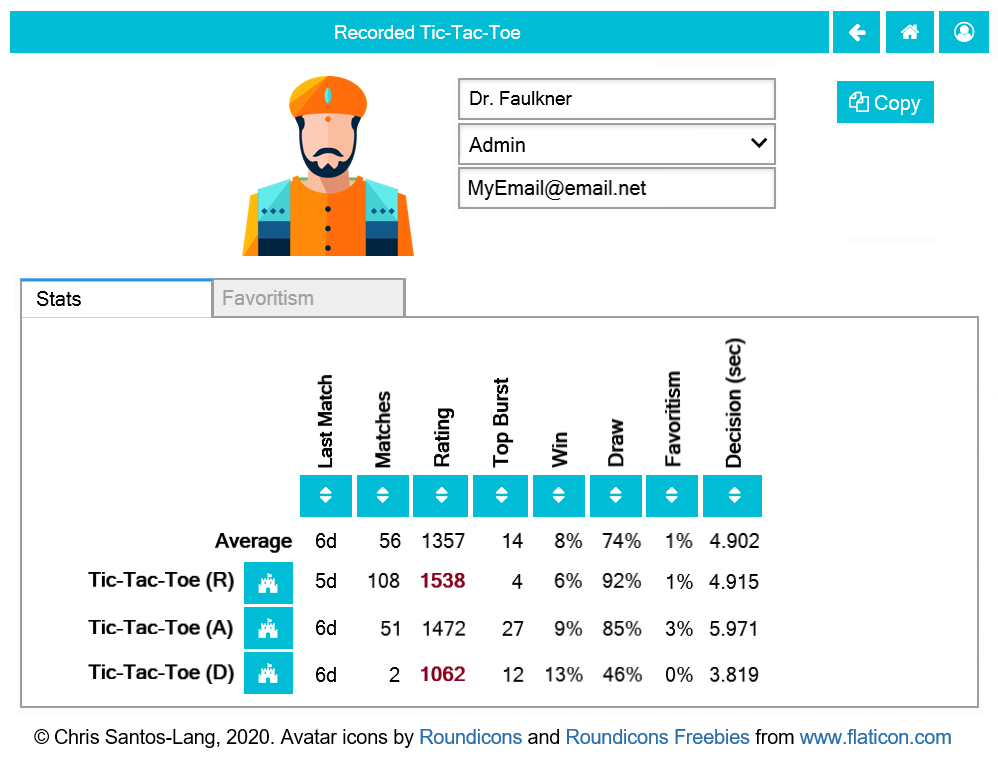
Shown as of 1.3 Ranked Tic-Tac-Toe (to anticipate the evolution of
the page). The tabs and their contents do not display in the current
version.
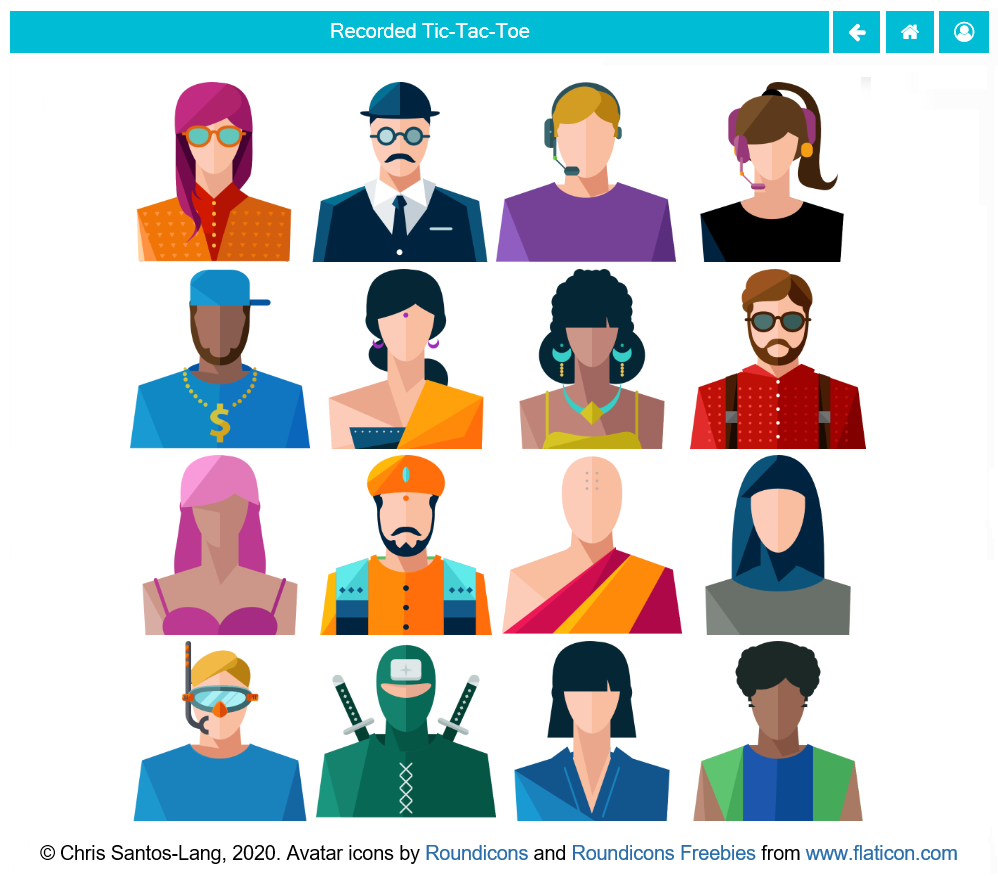
When the user is the creator or an Admin, clicking the Avatar
navigates to the AI Avatar page for AI players or to the Team
Avatar page other types of players. The initial avatar is
selected randomly for AI or Human players, but otherwise
matches the avatar of its creator.
The name text field does not accept whitespace, ‘*’, ‘(‘, or ‘)’.
The “Copy Player” button (fa-files-o) saves the current record and
opens a Player page for a new player (Persona if copied from a
Human player).
For Persona and other non-human players, display the player type
(disabled after first save) instead of security level, and universe
(disabled after first save) instead of email. Hide email unless the
user is the owner of the email or is an admin.
The stats table is sorted by Last Match (most recent on top). For
human players, display the type of augmentation with the rules
(A=Alone, B=Debating, D=Delegating, R=Reviewing). The “Sort by
this Column” buttons re-display the table sorted by the values in
the associated column; if already sorted by that column, reverse
the order.
The “Play New Game” buttons (fa-fort-awesome) save the current
record and navigate to the Home Page with the associated game
and this player prefilled. It displays only for non-human players,
friends, and personas created by the user.
The Rating, Accuracy, F1, Long-Game, Teach, and Empath numbers
are “Show Evolution” buttons which save the current record and
navigate to the Evolution Page with this player, the associated
game (and augmentation) and score selected. The rating displays
a conservative estimate, but displays in bold if within a
standard deviation of the maximum rating for that game among all
player/augmentation combinations.
The Favoritism numbers are “Show Favoritism” buttons which
navigate to the Favoritism tab with the associated game (and
augmentation) selected.